Decades of Despair: A 90-Year-Old Woman’s Struggle for Justice Over Family Land
In 2018, the Judiciary launched a countrywide initiative aimed at clearing a backlog of cases older than five years.
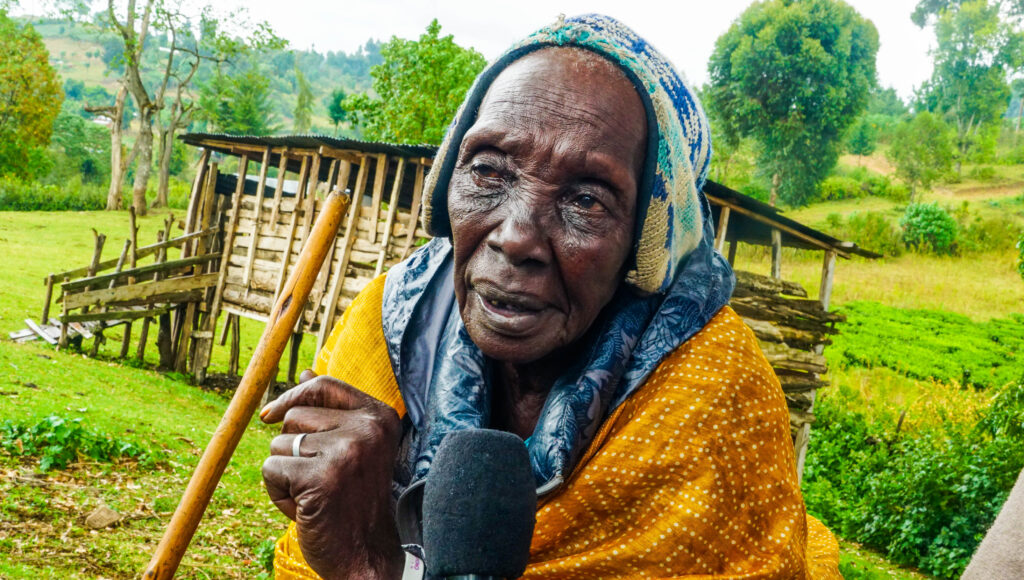
Cheptanui Sinyei Rotich, an 80-year-old matriarch, stands outside her homestead in Elgeyo Marakwet, her expression reflecting decades of sorrow and resilience amid a relentless 48-year land dispute.
By George Misati
Nestled within the scenic hills and valleys of Elgeyo Marakwet lies a homestead with a story that defies the tranquil beauty of its surroundings.
For Cheptanui Sinyei Rotich, a 90-year-old matriarch, this land is more than her home—it is her heritage, her livelihood, and the center of a legal battle that has consumed nearly half a century of her life.
Sinyei inherited the 44-acre parcel of land from her late mother decades ago. Today, however, what should be a peaceful retirement is overshadowed by a relentless legal battle. “I have fought for this land for 48 years,” she says. “The Kenyan justice system has failed me greatly.” Her battle began in 1978 when seven alleged land grabbers, with the support of two of her estranged sons and the area chief, sought to evict her.
The Hubz team traveled through two counties—Uasin Gishu and Trans Nzoia—to reach Sinyei’s homestead. As we arrived, the rain was falling steadily, adding an eerie calm to a place steeped in turmoil. Sinyei’s modest home, surrounded by fertile farmland, reflects a life of resilience. Yet, decades of court proceedings and physical confrontations have left deep scars on both her and her family.
Sinyei’s daughter, Mary Rotich, shares her mother’s anguish. “The situation has left us trapped,” she explains. The grabbers have allegedly blocked the feeder road that connects their home to the church, isolating them further. “We cannot even take my mother to her church. Our lives have been completely disrupted.”
Adding to their woes is the impossibility of developing their land. “We had plans to expand, to make this land more productive,” Mary says. “But with the case still unresolved, we are stuck. We are prisoners on our own land.”
The women’s ordeal goes beyond legal frustration. They recount moments of physical violence at the hands of those trying to take the land. “They raided our home,” Mary recalls, tears welling up. “We were beaten, humiliated, and left to pick up the pieces. How can we live like this?”
The unresolved case, which has traversed several courts over the years, underscores a broader issue within Kenya’s judiciary system. In 2018, the Judiciary launched a countrywide initiative aimed at clearing a backlog of cases older than five years. This drive was informed by a status report revealing that 27% of cases in the Judiciary classified as backlog were older than five years. While the initiative was widely praised as a proactive measure, it is clear that some cases, especially those involving complex land disputes, continue to languish in the system.
Activist Kimutai Kirui, a prominent voice in the region, has called out the judiciary for what he describes as a failure of justice. “This case has been moving from one court to another for nearly five decades,” Kirui says. “It is unacceptable that a matter so straightforward remains unresolved. The system is broken.”
The women are now placing their hopes in Chief Justice Martha Koome, urging her to take action. “We plead with the Chief Justice to hear our cries,” says Sinyei. “We need justice before it’s too late.” Mary echoes her mother’s sentiments, adding, “We cannot continue to live in fear and despair. This is our home, our heritage. We just want to live in peace.”
Kirui believes the case not only reflects inefficiencies in the judiciary but also exposes how land disputes disproportionately affect vulnerable populations. “If an 80-year-old woman cannot get justice after nearly 50 years, what does that say about our system?” he asks. “This is a gross miscarriage of justice, and it must be addressed.”
The Judiciary’s backlog clearance initiative in 2018 was a step in the right direction, demonstrating the willingness to address inefficiencies within the system. However, cases like Sinyei’s highlight the limitations of such efforts when older, unresolved disputes continue to stagnate.
As the rain continues to fall on the homestead, Sinyei and Mary cling to hope. Their plea is not just for themselves but for a justice system that protects the vulnerable and upholds the rule of law. “We have waited long enough,” Mary says with determination. “It’s time for the courts to act.”
This story serves as a somber reminder of the long road to justice faced by many Kenyans, even as initiatives to clear judicial backlogs have sought to address systemic delays. For Sinyei and Mary, the fight for their land is more than a legal battle—it is a fight for dignity, for heritage, and for a future free from fear.
About Author