By Grace Wafubwa
Grace Wafubwa is a Kenyan multimedia journalist with a focus on gender, human rights, and community development. Her reporting amplifies survivor voices and examines grassroots and policy-driven efforts to end harmful cultural practices.
Ntimaru, Migori County — For Mary Bhoke (not her real name), a Form Two student in Ntimaru Sub-county, Kuria East Constituency, the scars of female genital mutilation (FGM) are both physical and psychological. Cut at the age of 11 under the guise of “transitioning into womanhood,” Bhoke is among thousands of girls in western Kenya who have endured a practice outlawed in Kenya but still deeply entrenched within sections of the Abakuria community.
“I felt very nervous, but I had to comply since it was a continuation of customs passed down from our ancestors,” Bhoke recalled in an exclusive interview. Her ordeal took place in December 2020 in Mutarakwa village, where she and 15 other girls were subjected to the cut—an experience that nearly claimed her life.
A week before the procedure, five women—two of them her paternal aunts—visited her home. After a closed-door discussion under a mango tree, Bhoke was summoned and told she had “come of age” and was expected to undergo initiation. “My young mind did not immediately understand what was happening,” she said. She later learned that three of the women were traditional initiators operating in the area. Her mother subsequently explained that she herself had undergone the rite two decades earlier.
At dawn on the designated day, Bhoke and the other girls were escorted from their homes and paraded in an open field where the initiators carried out the practice. “You are not supposed to cry. They believe crying angers the ancestors and brings curses,” Bhoke said. Celebrations followed as mothers ululated and wrapped their daughters in lesos before escorting them home ahead of sunrise.
What followed was a medical emergency. Persistent bleeding led to hemorrhage and eventual loss of consciousness. “My world suddenly became dark,” she recalled. Bhoke later regained consciousness at Ntimaru Sub-county Hospital, where she underwent emergency surgery and blood transfusions during a three-week admission. Although she survived, she says she still struggles to walk upright, and memories of the ordeal continue to affect her mental well-being.
Her experience echoes that of 17-year-old Brenda Machera (not her real name), a Form Three student who underwent FGM due to peer pressure rather than coercion by family members. “Fear, isolation, and stigma pushed me into it so I could fit in with my peers,” Brenda said. While her case did not result in serious medical complications, she says the emotional scars remain and has since vowed to campaign against the practice.
Brenda now works closely with community advocates such as Rhoda Ghati Marowa, a high school teacher and leader at Matare Seventh Day Adventist (SDA) Church. A survivor herself, Marowa founded an anti-FGM outreach unit within the church to challenge myths, reduce fear, and empower girls and women. “The church plays a critical role in restoring dignity and adding a voice of reason against harmful cultural beliefs,” she said. Her work has contributed to the establishment of integrity clubs in local schools to nurture anti-FGM champions among students and teachers.
Youth-led advocacy is also gaining momentum. “I am not only a role model to young girls; I am bridging past, present, and future generations,” said Tabitha Ghati, 24, an anti-FGM advocate and recent Bachelor of Education graduate from Kenyatta University. “We need to work together to change mindsets and protect the next generation.”
Men in the community are increasingly joining the campaign. Moses Wanka, founder of the Quick Peace for Africa Community Based Organisation (CBO), leads the Angamiza Tohara kwa Wanawake (End FGM) campaign in partnership with organisations such as NAYA Kenya. Founded in 2024, the CBO offers financial literacy, psychosocial support, and reintegration assistance to FGM survivors, widows, and girls rescued from circumcisers.
“Girls’ rights to healthcare and education are not negotiable,” said Lucas Matiko, a healthcare worker in Ntimaru and a father of four daughters. He regularly engages parents through community forums to promote positive behavioural change. However, he noted that efforts are often undermined by cross-border FGM, with circumcisers moving between Kenya and Tanzania to evade law enforcement.
At the border, long-time activist Moses Gikaro works closely with police to track and repatriate girls taken to Tanzania for the procedure. “This month alone, I have rescued six minors and placed them in safety camps,” he said.
Local administrators remain on the front line despite resistance. Itongo sub-location Assistant Chief John Rioba has intensified community policing efforts, encouraging residents to report planned cases. “During this December school holiday alone, we rescued more than 300 girls,” he said. However, he acknowledged persistent challenges, including the lack of a safe house in Ntimaru. “We are forced to seek shelter services in neighbouring sub-counties, which is exhausting and unsustainable,” he added, urging the government to establish a rescue centre in the area.
According to the Kenya Demographic and Health Survey (KDHS) 2022, national FGM prevalence among women aged 15–49 has declined to 15 percent, down from 21 percent in 2014 and 38 percent in 1998. Among girls aged 15–19, prevalence has dropped to 9.1 percent, signaling progress among younger generations. The survey also shows that 92 percent of women and 93 percent of men believe the practice should end.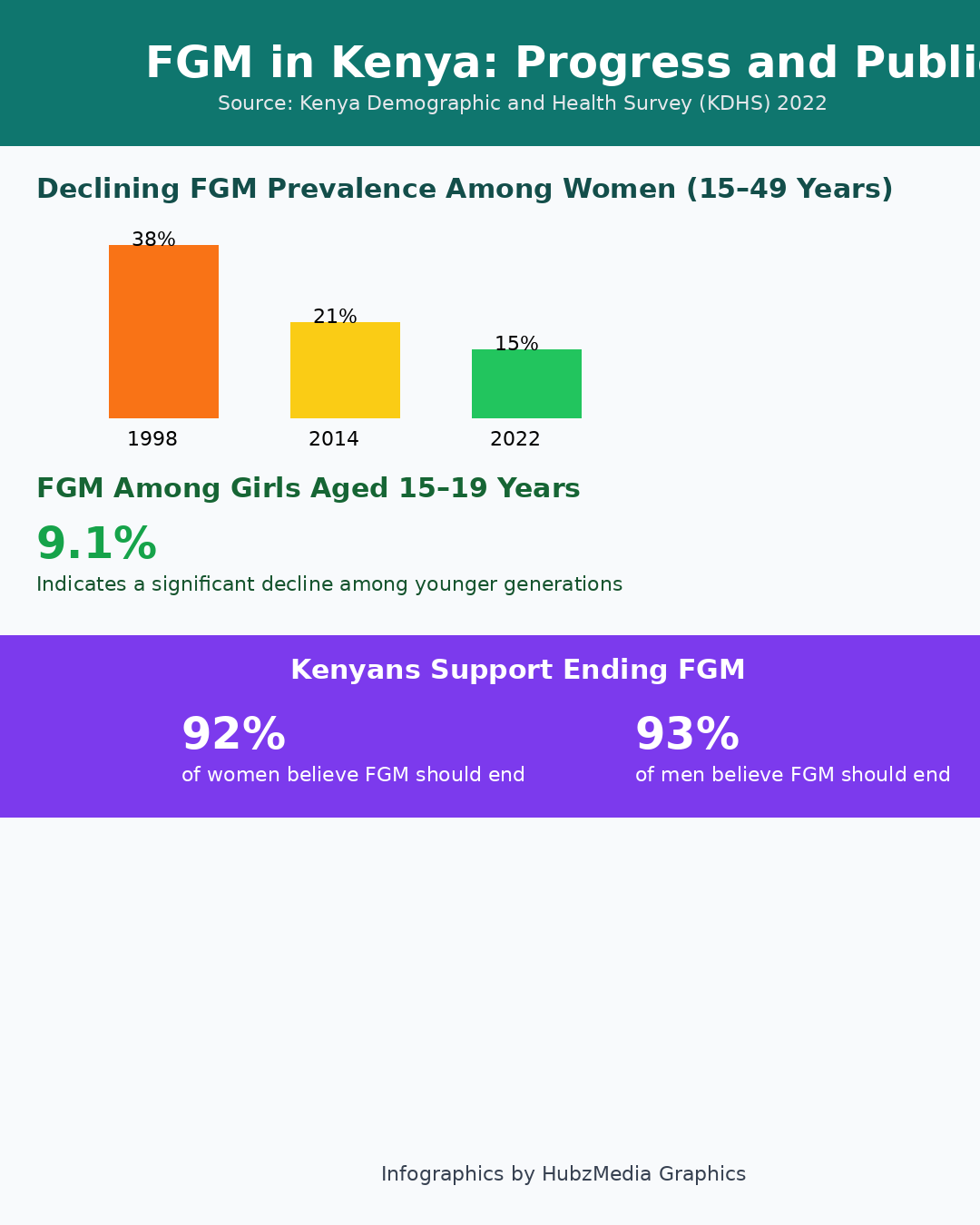
The Anti-FGM Board of Kenya, a semi-autonomous government agency, is coordinating national efforts to eliminate the practice by 2030 in line with a presidential directive and Sustainable Development Goal 5.3. Community leaders in Ntimaru hope this commitment will translate into targeted investments, including permanent rescue and rehabilitation facilities.
As Kenya marks the 16 Days of Activism Against Gender-Based Violence, the story unfolding in Ntimaru reflects both the persistence of harmful traditions and a growing resolve among survivors, advocates, and authorities to end FGM and safeguard the rights and dignity of girls.