Senate Committee Reviews Landmark Environmental Regulations in Machakos
This requirement applies across all government and private sector entities, including county governments, ministries, and agencies.

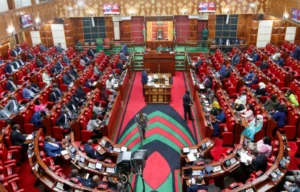
Senate Committee on Delegated Legislation, chaired by Senator Danson Mungatana, reviews key environmental regulations during a retreat in Machakos County on 17th May 2025. Photo/Parliament of Kenya.
By Robert Assad
The Senate Committee on Delegated Legislation has commenced a comprehensive review of key environmental regulations published by the Ministry of Environment, Climate Change and Forestry.
Meeting in Machakos County on Saturday, 17th May 2025, the Committee held a retreat session chaired by Vice-Chairperson Senator Danson Mungatana (Tana River), where members deliberated on the legislative frameworks and made several critical observations and recommendations.
The first set of regulations under scrutiny was the Environmental Management and Co-ordination (Strategic and Integrated Environmental Assessment and Environmental Audits) (No. 2) Regulations, 2025.
Developed under Section 147 of the Environmental Management and Co-ordination Act (Cap. 387), the regulations overhaul the processes of environmental licensing, assessments, audits, and compliance monitoring.
These regulations require that any proposed project with potential environmental impacts must undergo an integrated environmental assessment before approval by the National Environment Management Authority (NEMA).
This requirement applies across all government and private sector entities, including county governments, ministries, and agencies.
The regulations introduce a structured registration and licensing system for environmental assessment experts, with NEMA responsible for issuing annual practising licences and maintaining a public list of certified practitioners.
Risk categorisation determines the level of assessment needed—low-risk projects require only a summary report, medium-risk projects must submit a comprehensive report, and high-risk initiatives are subject to full environmental study reports and stringent review.
A provision allowing projects to proceed if NEMA fails to respond within 45 days is included to prevent bureaucratic delays.Strategic environmental assessments for national-level policies or programmes are also addressed.
If deemed necessary by NEMA, a Kshs. 1 million fee is levied to ensure comprehensive review. The regulations repeal the outdated 2003 Environmental (Impact Assessment and Audit) Regulations, reflecting Kenya’s evolving environmental priorities.
The Committee also reviewed the Environmental Management and Co-ordination (Access to Biological Resources and Benefit Sharing) (No. 2) Regulations, 2025, which aim to domesticate the Nagoya Protocol.
These regulations promote equitable access to biological resources while safeguarding the rights of local communities. A licence from NEMA is required for access to such resources, and the regulations empower NEMA to protect endangered species and maintain a national biodiversity inventory updated every five years.Importantly, the regulations embed indigenous knowledge systems into the conservation process.
County Environment Committees must submit community protocols detailing rules for engagement with biological resource users. Application fees vary based on the applicant’s category, with subsidised rates for academic research and significantly higher fees for commercial access.
Access permits also require Prior Informed Consent (PIC) and Mutually Agreed Terms (MAT), while exports of genetic material must be accompanied by a Material Transfer Agreement (MTA). A strong benefit-sharing framework ensures communities gain from the use of their resources.
Finally, the Committee examined the Environmental Management and Co-ordination (Deposit Bonds) (No. 2) Regulations, 2025, which introduce financial assurance mechanisms for high-risk activities.
Projects in sectors like extractives, large-scale agriculture, and hazardous transport must deposit bonds with NEMA, refundable upon successful project completion and environmental compliance.
These funds can be used for remediation in case of environmental violations.While the Committee welcomed the alignment of the regulations with global environmental standards, concerns were raised regarding the cost burden on small-scale developers and community groups.
Further stakeholder consultations will be undertaken before the Committee reaches a decision on whether to adopt or annul the proposed regulations.
About Author