Ruto Signs Law Cutting VAT on Fuel to 8pc for 90 Days
The new measure extends an earlier VAT reduction introduced in April, whose initial 90-day period and subsequent extension expired on October 14.
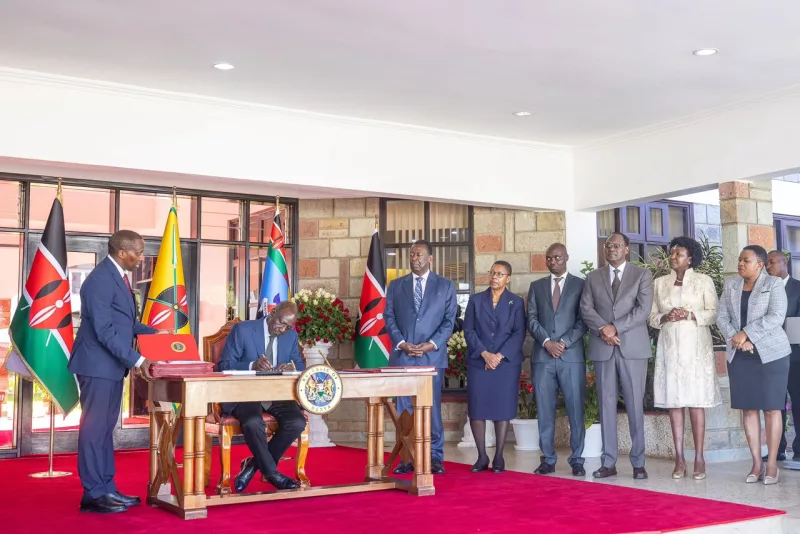
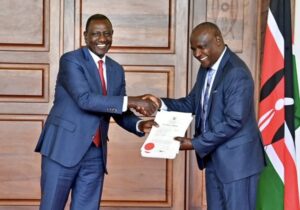
President William Ruto signs two tax laws introducing temporary relief on petroleum products and changes aimed at reducing construction costs while strengthening revenue collection. Photo: The Star Kenya.
By Robert Mutasi
President William Ruto has signed two tax laws introducing temporary relief on petroleum products and changes aimed at reducing construction costs while strengthening revenue collection.
Ruto assented to the Tax Laws (Amendment) Act, 2026, and the Kenya Revenue Authority (Amendment) Act, 2026, at Eldoret State Lodge in Uasin Gishu County on Friday.
The Tax Laws (Amendment) Act reduces Value Added Tax (VAT) on petroleum products from 16 per cent to eight per cent for 90 days. The National Treasury Cabinet Secretary may extend the relief for a further 90 days if necessary.
The new measure extends an earlier VAT reduction introduced in April, whose initial 90-day period and subsequent extension expired on October 14.
Parliament said the extension was necessary because the crisis in the Middle East, which has contributed to fluctuations in global oil prices, had continued beyond the period initially expected.
The relief is intended to cushion households against rising transport costs and prevent higher fuel prices from pushing up the cost of essential goods and services.
It is also expected to give the Energy and Petroleum Regulatory Authority (EPRA) room to maintain prevailing fuel prices and limit the impact of global oil market volatility on consumers.
The Bill, sponsored by National Assembly Majority Leader Kimani Ichung’wah, was introduced in the National Assembly on October 8 and passed with amendments on October 14.
Changes to construction taxes
The law also introduces changes to excise duty on construction materials in a move aimed at easing costs in the building and housing sector.
Under the amendments, excise duty on tiles will be calculated based on size rather than weight, reflecting how the products are commonly sold by square metre.
The previous weight-based system, introduced in June, had increased the cost of tiles, prompting the need for a review.
Excise duty on sanitary ware, including ceramic sinks, wash basins, baths, bidets, water closet pans, flushing cisterns and urinals, has also been reduced from Sh50 to Sh30 per kilogramme.
The law further addresses the taxation of imported float glass and other glass products from the East African Community to ensure they are not subjected to excise duty contrary to the EAC Customs Protocol.
Parliament said the changes are expected to lower construction expenses for government and private sector projects, including affordable housing developments.
KRA gets new funding framework
Separately, the Kenya Revenue Authority (Amendment) Act, 2026, introduces changes to the tax agency’s governance, financing and revenue collection operations.
The law provides for substantive membership of all KRA board members, removing ex-officio membership. It also adds the Managing Director of the Kenya Ports Authority to the board to improve coordination between the two institutions.
KRA will receive guaranteed funding equivalent to at least two per cent of the revenue it estimates collecting in each financial year.
The legislation also provides for an incentive equivalent to three per cent of revenue actually collected in a quarter above the amount projected for that period.
Other amendments update the laws governing revenue administration by removing repealed legislation and aligning references with current laws.
According to the parliamentary brief, improving KRA’s efficiency is expected to strengthen revenue collection and reduce pressure for additional taxation.
The government is seeking to balance relief for consumers and businesses with efforts to improve domestic revenue mobilisation as households continue to face pressure from the cost of living.
About Author