Teen Mothers: Rebuilding Dreams in Nyamira and Homa Bay
“The whispers began almost immediately. Many mothers told their daughters not to walk with me. I felt like everyone had turned against me.”
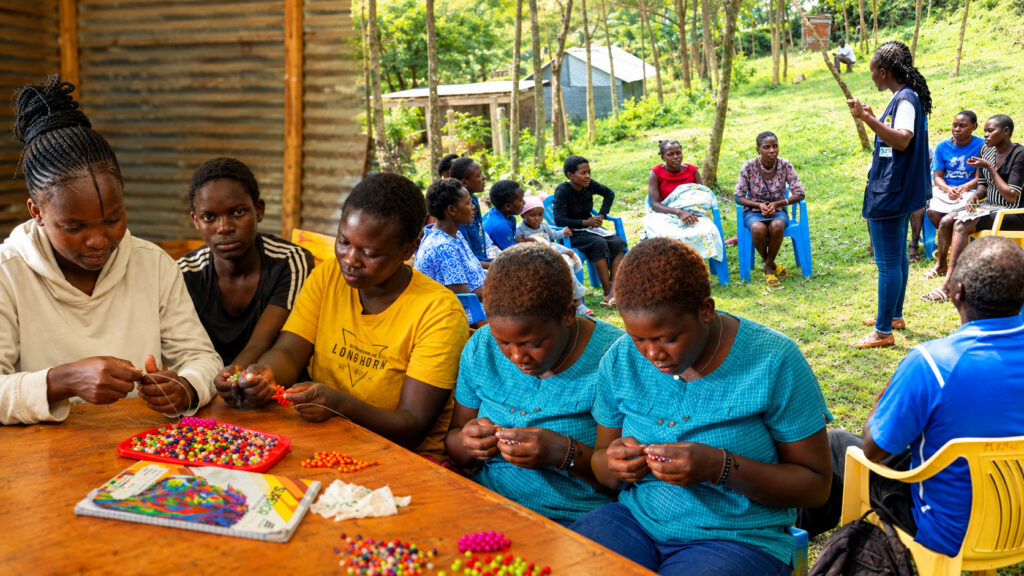
Some of the handmade artefacts produced by teenage girls from Kocha, alongside Rehema of KMET during a session with teen mothers in Homa Bay.
By Grace Wafubwa
Edited by James Gitaka
In the lush, green hills of Nyamira County, tea plantations stretch across the landscape, interspersed with fertile farms that have long sustained communities.
But beneath the county’s picturesque scenery is a quieter crisis—one that continues to disrupt the lives of adolescent girls, interrupt their education and force them into motherhood before they are emotionally, physically or financially prepared.
Poverty, period poverty, peer influence, incest, limited opportunities and, in some cases, relationships between adolescent girls and older men are among the factors driving teenage pregnancies.
For many girls, pregnancy marks not only the beginning of motherhood but also the sudden end of a childhood they had expected to spend in school, among friends and planning for the future.
Just five kilometres from Nyamira Township, Manga Centre is one of the areas reporting a high number of teenage pregnancies. Behind its quiet villages are stories of interrupted education, fractured family relationships, stigma—and, increasingly, attempts by young mothers to rebuild their lives.
A pregnancy that changed everything
At 15, Sheila Kwamboka was a Form Two student at a nearby day secondary school when she discovered she was pregnant.
The father of her unborn child, a fellow classmate, denied responsibility, leaving Sheila to confront the pregnancy largely on her own.
News of the pregnancy spread quickly through the village.
“The whispers began almost immediately. Many mothers told their daughters not to walk with me. I felt like everyone had turned against me.”
At home, the pregnancy exposed tensions within the family. Sheila’s father blamed her mother, accusing her of failing to guide their daughter.
Yet amid the anger and disappointment, her mother chose compassion over condemnation.
A devoted Seventh-day Adventist believer, she accompanied Sheila to Manga Dispensary for her first antenatal clinic visit. Healthcare workers confirmed that the teenager was already four months pregnant.
“That is when reality hit me so hard. There was nothing we could change. I had to accept the situation and stand by my daughter.”
For the next five months, Sheila’s mother ensured that her daughter attended every antenatal appointment, received nutritional supplements and followed medical advice.
“Blaming her would not change anything. My responsibility was to make sure she had a safe pregnancy and delivered a healthy baby.”
Months later, Sheila safely delivered a healthy baby boy.
Her experience is one of many unfolding around Manga Centre, where teenage mothers are finding ways to support one another and regain a measure of control over their lives.
Every week, young mothers meet through a support group where they share experiences, encourage one another and participate in table banking.
Through the initiative, members save money and access small loans to support their families.
Turning motherhood into a new beginning
Among them is 17-year-old Veronica Nyanjama, who gently cradles her two-year-old daughter.
Her journey into motherhood was equally difficult.
When Veronica told her boyfriend she was pregnant, he disappeared. Friends encouraged her to terminate the pregnancy and return to school, but she chose to keep her baby.
Although her mother initially struggled to accept the pregnancy, she eventually became Veronica’s strongest source of support during pregnancy and delivery.
Today, Veronica is pursuing a different path.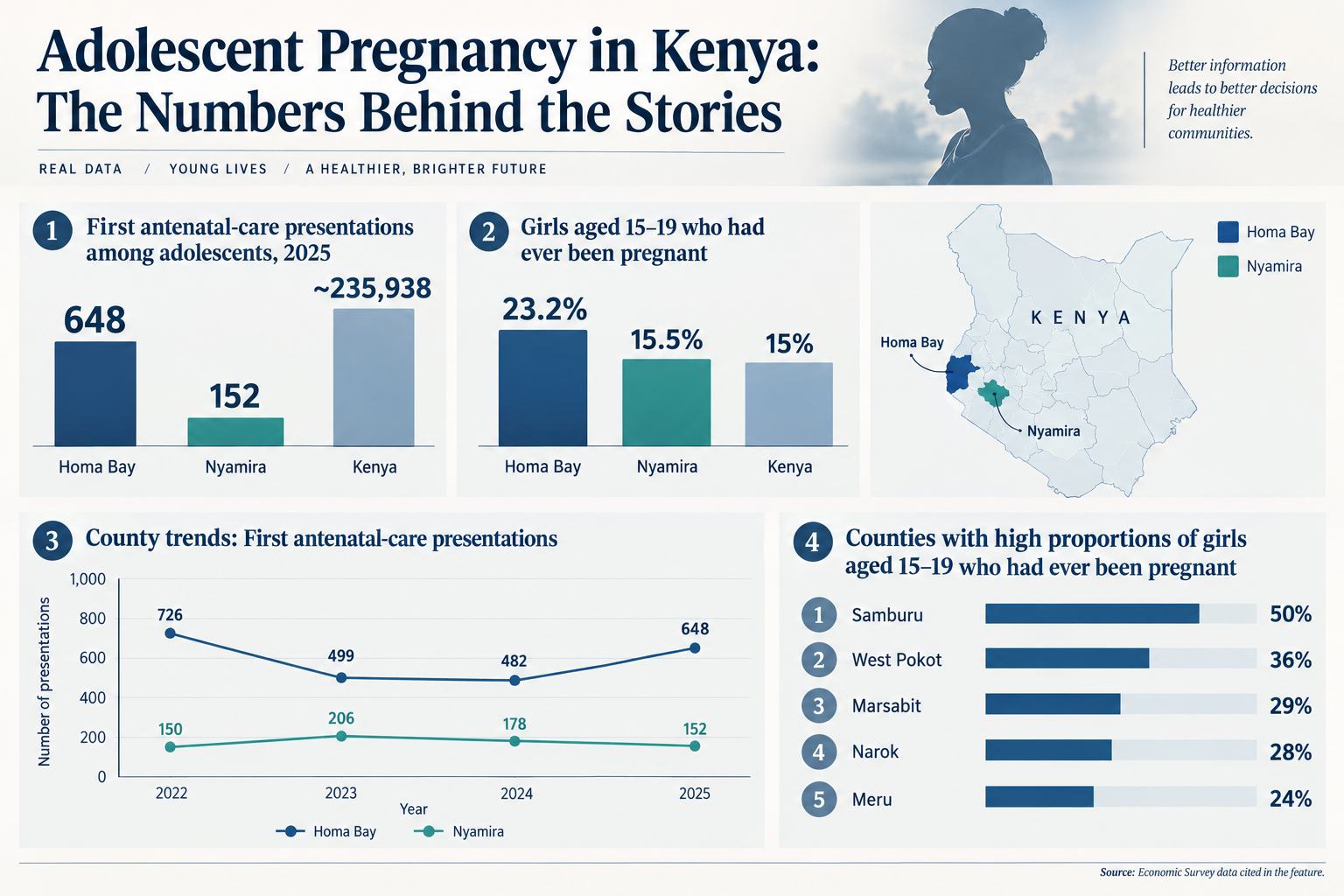
Rather than returning to secondary school, she enrolled at a Technical and Vocational Education and Training institution, where she is training as a beautician.
“I want to own a successful beauty business. I want to provide for my daughter and prove that becoming a teenage mother does not mean the end of my dreams.”
For Veronica and other young mothers, rebuilding their lives also means finding ways to earn an income.
Through communal farming, they grow vegetables and other fresh produce for sale in local markets.
Together with table banking, the activities generate income that helps the young mothers meet household needs and care for their children.
“At least now I can afford to buy diapers and other essential items. I really don’t want to rely entirely on my parents. I want to provide for my child and build a better future for both of us,” Veronica said.
The livelihood activities form part of a wider intervention by the Kenya Medical Education Trust (KMET), which works with vulnerable adolescent girls to restore hope after teenage pregnancy.
Through the programme, beneficiaries receive psychosocial counselling, financial literacy training, mentorship, livelihood support and accurate sexual and reproductive health information.
Across the region, another generation of young mothers
The experience of teenage motherhood is not confined to Nyamira.
Across the region in neighbouring Homa Bay County, a similar story is unfolding.
In Kochia, 17-year-old Beryl Akinyi cradles her one-and-a-half-year-old son as she prepares porridge over a charcoal stove.
Her journey into motherhood began while she was still in secondary school.
Akinyi had befriended a boda boda rider—a married father of three whom she met during her daily journey to school.
For the teenager, it was her first relationship.
Coming from a humble background, Akinyi says the attention, gifts, new clothes and even new hairstyles made her feel loved and valued.
The relationship eventually became sexual.
When she disclosed that she was pregnant, the man initially promised to support her. But he soon disappeared to another town and blocked all communication.
“I believed he would come back because I loved him. But as the pregnancy progressed, I realised I was completely alone.”
Her return home was met with rejection.
Her family was already struggling after another daughter had become pregnant while in Form Three. Her mother told her to return to where she had found the pregnancy.
But intervention by a Community Health Volunteer helped change the situation.
The CHV counselled both mother and daughter, helping them reconcile and begin the difficult process of accepting the pregnancy.
Today, Akinyi has transformed part of her experience into an opportunity to rebuild her life.
Strong in mathematics, she serves as treasurer of the young mothers’ support group, helping manage its finances and accountability.
The group has also turned creativity into an income-generating opportunity.
The young women make handcrafted bangles, necklaces and headbands, as well as handwoven mats, which they sell across the country.
They also grow indigenous vegetables for markets in Homa Bay, Kisumu and neighbouring towns.
One of their handcrafted artefacts was purchased by the Homa Bay governor during last year’s Devolution Conference—an experience that gave the young mothers renewed confidence in the value of their skills.
The group is now planning to venture into poultry farming.
For Akinyi, motherhood has altered the direction of her life, but it has not erased her ambition.
“We decided to use our creativity to earn a living and become financially independent. I may not go back to school because I have already become an entrepreneur. I want to use the skills and resources I have gained to raise my son and give him the opportunities that I never had.”
The economic activities are part of KMET’s wider intervention to equip adolescent mothers with practical skills while helping them regain confidence and independence.
Beyond income: the need for health and psychological support
But rebuilding the lives of young mothers requires more than economic empowerment.
Their health—and the health of their children—remains central.
Julie Oyoo, the Sub-county nutritionist working with adolescent mothers in Homa Bay, provides guidance on maternal and child nutrition, breastfeeding, child growth and development, as well as the nutritional needs of young mothers during and after pregnancy.
Her work has exposed her to deeply troubling cases involving girls with intellectual disabilities who have reportedly been sexually abused by family members.
Such cases, she says, highlight the vulnerability of some girls and the need for stronger community surveillance, protection and referral systems.
Working closely with Community Health Volunteers has significantly expanded the programme’s reach, she says.
“Working closely with the Community Health Volunteers has really strengthened our reach. They know these communities and are able to identify vulnerable girls, follow them up at home and connect them with the services they need. This has greatly improved our output and access to girls who would otherwise remain unreached.”
Through home visits and community follow-up, CHVs identify vulnerable girls, monitor the health of mothers and children and connect families to health and protection services.
That community-level link has become an important bridge between vulnerable girls and the support available through health facilities and other services.
According to KMET Homa Bay Coordinator Yvone Sewe, empowering the girls with life skills and economic opportunities is only one part of the intervention.
Through collaboration with Homa Bay County Referral Hospital, KMET has also linked vulnerable girls to psychologists who provide professional mental health guidance and psychosocial support.
The goal is to help girls cope with pregnancy, abandonment, family rejection, stigma and the emotional consequences of becoming mothers while they are still adolescents themselves.
“We realised that empowering these girls with life skills alone is not enough. Some of them are going through very difficult emotional experiences, and they need professional support to cope and rebuild their lives.”
For some girls, the psychological burden begins even before childbirth.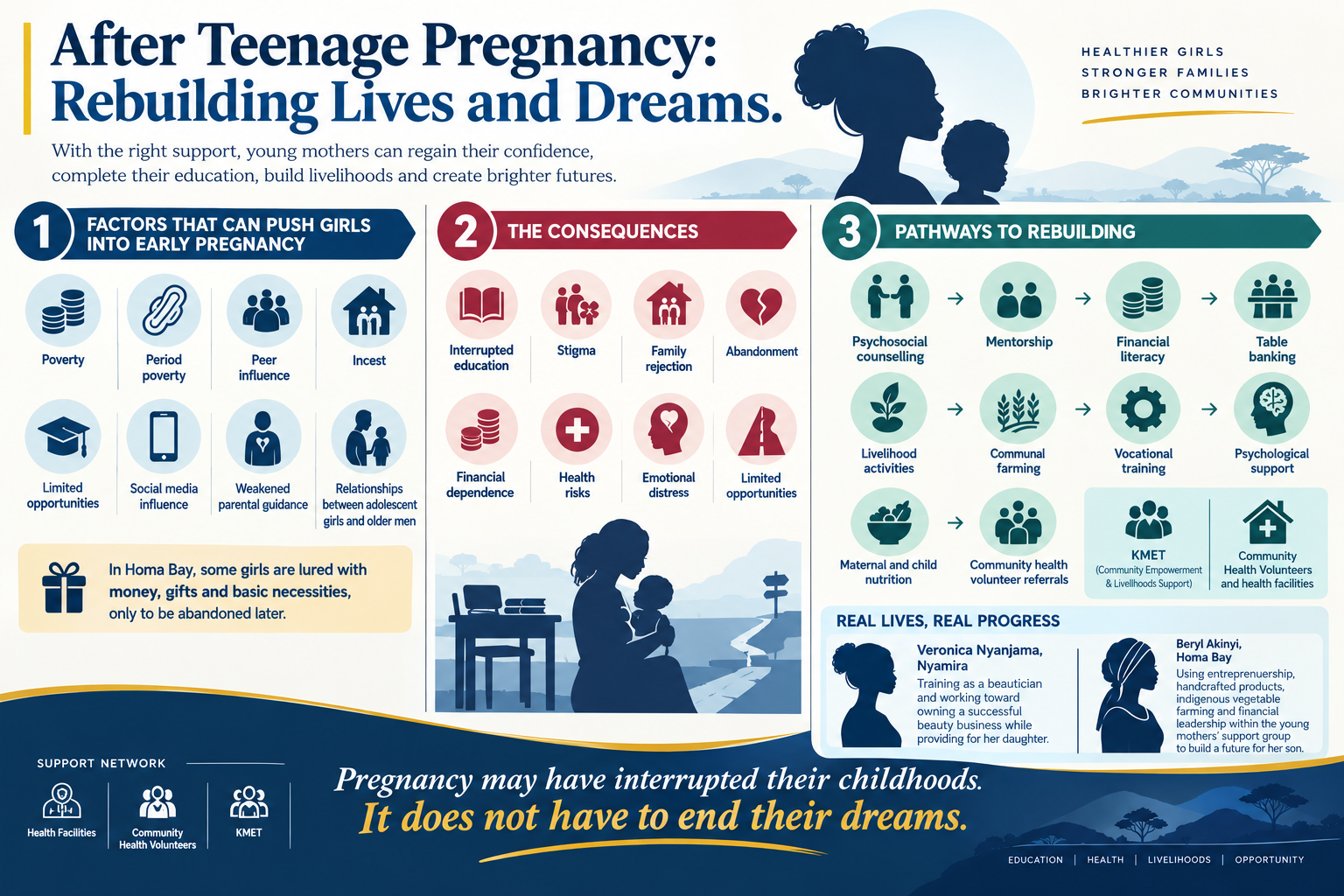
Georgina Achieng, a psychologist working with the programme at Hope Center, Homa Bay County Referral Hospital, says teenage pregnancy can place a severe mental and emotional burden on girls who are still navigating adolescence.
“The mental health burden can be severe. These are young girls who are still trying to understand themselves, yet they are suddenly expected to deal with pregnancy, motherhood and, in some cases, rejection from their families. They have to worry about their own mental wellbeing while also carrying an unborn child.”
Achieng says early identification, counselling and professional support are critical in helping girls process their experiences, regain confidence and prepare emotionally for motherhood.
Through the collaboration, girls identified by Community Health Volunteers can be referred for professional psychological support, creating a continuum of care that links communities to health facilities and other support services.
The circumstances behind the pregnancies
Yet even as interventions help young mothers rebuild their lives, the circumstances pushing girls into early pregnancy remain a concern.
A Community Health Volunteer in Homa Bay says boda boda riders remain among the contributors to teenage pregnancies in Kochia and neighbouring communities.
Some girls, she says, are lured with money, gifts and basic necessities, only to be abandoned when they become pregnant.
She also says many families choose to settle cases privately rather than pursue legal action, allowing perpetrators to escape accountability.
“When these cases are resolved within families, the perpetrators are rarely brought to justice. That not only denies justice to the girls but also leaves other vulnerable adolescents at risk.”
The challenge is also visible in Nyamira.
Nyamira County Director of Nursing Karen Ateka attributes continued teenage pregnancies to factors including poverty, incest, peer influence through social media and weakened parental guidance.
She says some parents have increasingly delegated responsibility for guiding and mentoring their children to schools, churches and other institutions.
At the same time, many adolescents are turning to social media for information about relationships and sexuality, often without adequate guidance.
“Parents have left the responsibility of raising their children to others. Today many teenagers are getting information from social media without proper guidance. That is one of the reasons we continue to witness rising cases of teenage pregnancy.”
The county is also witnessing adolescents seeking treatment following unsafe abortions.
“We continue to receive many post-abortion cases involving teenagers. Many girls become desperate because they fear stigma, rejection and dropping out of school.”
Health officials say reversing the trend will require stronger parental involvement, improved access to menstrual hygiene products, comprehensive sexuality education, youth-friendly reproductive health services and community support to protect vulnerable girls before they become victims.
The numbers behind the stories
Behind the individual experiences is a broader picture reflected in Kenya’s health data.
The Economic Survey, using health-facility data, recorded 648 adolescents presenting with pregnancy at their first antenatal care visit in Homa Bay in 2025, compared with 152 in Nyamira.
The Homa Bay figure is particularly striking against the county’s recent trend: 726 adolescent first-ANC presentations were recorded in 2022, followed by 499 in 2023, 482 in 2024 and 648 in 2025.
Nyamira recorded 150 in 2022, 206 in 2023, 178 in 2024 and 152 in 2025.
At the national level, the latest administrative data show the scale of the challenge. Kenya recorded about 235,938 adolescent first antenatal-care visits in 2025, according to analysis of Economic Survey data.
The survey found that 15 per cent of Kenyan adolescent women aged 15 to 19 had ever been pregnant, down from 18 per cent in 2014.
Homa Bay, however, remained substantially above the national average, with 23.2 per cent of girls aged 15 to 19 having ever been pregnant.
In Nyamira, the corresponding figure was 15.5 per cent, placing the county close to the national level.
At the national level, the highest proportions were recorded in counties including Samburu at 50 per cent, West Pokot at 36 per cent, Marsabit at 29 per cent, Narok at 28 per cent and Meru at 24 per cent.
The differences between counties underline a critical point: teenage pregnancy is not simply a national health problem. Its prevalence is shaped by local economic conditions, access to education, social norms, child protection, reproductive health information and the strength of family and community support systems.
For Homa Bay, the latest figures reinforce the urgency of addressing the vulnerabilities facing adolescent girls in communities around Lake Victoria.
For Nyamira, the challenge is equally complex, requiring interventions that take into account the realities of tea-growing communities while strengthening parental guidance, menstrual health support, school retention and access to adolescent-friendly services.
And for the young mothers themselves, perhaps the most important message is also the simplest.
Pregnancy may have interrupted their childhoods.
It does not have to end their dreams.
About Author