Government Kicks Off Plan to Pull in Sh1 Trillion for Sustainable Food Production
The government, in partnership with GIZ and AKADEMIYA2063, has unveiled a new programme aimed at sustainably financing Kenya’s agri-food systems.
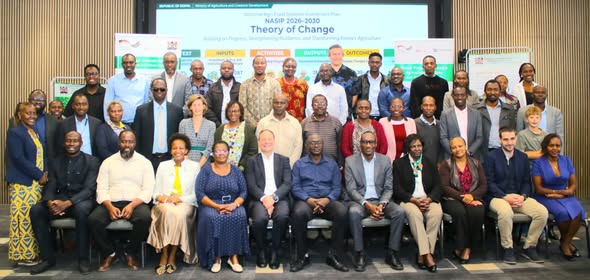
Stakeholders from government, county administrations, development partners, farmers’ groups, civil society and the private sector pose for a group photo during the National Agri-food Systems Investment Plan (NASIP) 2025–2029 sensitization workshop in Nairobi.Photo/Courtesy
The government, via the Ministry of Agriculture and Livestock Development , working together with German Agency for International Cooperation (GIZ) and AKADEMIYA2063, has rolled out a new programme. The idea is to sustainably finance Kenya’s agri-food systems, then generally shift how food is produced across the whole country, kinda in one run.
Speaking at a national awareness and sensitization workshop on Kenya’s National Agri-food Systems Investment Plan (NASIP) 2025–2029, Agriculture Principal Secretary Paul Kiprono Rono said the initiative will aim at strengthening the CAADP commitments, especially the ones under the Kampala Comprehensive Africa Agriculture Development Programme.
“NASIP is not merely an investment framework; it is a transformative blueprint, meant to stitch production, processing, logistics, finance, technology and trade into one agri-food system,” Rono said.
As the PS put it, the plan seeks to mobilise more than Sh1 trillion for strategic investments, while also backing climate resilience, digital agriculture, food safety, and empowerment for youth and women within the agricultural space.
Rono also said the workshop was meant to make sure NASIP implementation matches national planning , budgeting and policy review pathways, and it should also tighten coordination between national and county governments.
He added that stakeholders will get a clearer picture of the Kampala diagnostics that AKADEMIYA2063 developed, and how those diagnostics feed into Kenya’s broader agri-food transformation agenda.
The initiative is targeting sustainable food production, agro-industrialisation, more agricultural trade, improved financing for agri-food systems, food and nutrition security , plus inclusive livelihoods and stronger governance structures.
“In January 2026, the Kampala CAADP Declaration on Building Resilient and Sustainable Agri-food Systems came into force to accelerate agri-food systems transformation across Africa,” Rono said.
He explained that the declaration basically moves away from the older thinking of “just grow agriculture” toward a wider agri-food systems lens, linking agriculture, nutrition, health and environmental sustainability, all together.
The PS emphasized that agriculture still stays a core pillar of Kenya’s economy , contributing heavily to GDP, jobs, food security and even export earnings.
Still, he acknowledged the sector keeps running into stubborn challenges, like low productivity, weak value-chain integration, limited private investment and the usual vulnerability to climate change and market shocks.
“These realities call for bold, coordinated and evidence-driven interventions capable of unlocking the full potential of the agri-food economy,” Rono stated.
The National Agri-food Systems Investment Plan, created under the Ministry of Agriculture and Livestock Development through the Agricultural Transformation Office, is said to align with Kenya’s Agricultural Sector Transformation and Growth Strategy, the Bottom-Up Economic Transformation Agenda and Vision 2030.
The government expects the programme to accelerate agricultural GDP growth, boost food security, expand value addition , increase private sector engagement and generate jobs. It also hopes to improve climate resilience at the same time, no doubt.
Rono said hitting the set targets will depend on strong partnerships, creative financing arrangements and accountability from every stakeholder involved, together.
The workshop brought in representatives from government agencies, county governments, development partners, farmers’ organisations, civil society groups, private sector players, research institutions, and academic stakeholders.
Organisers said the conversations will also build momentum ahead of the FINAS Conference 2026 by pointing out priority investment and financing needs for the agri-food sector.
About Author