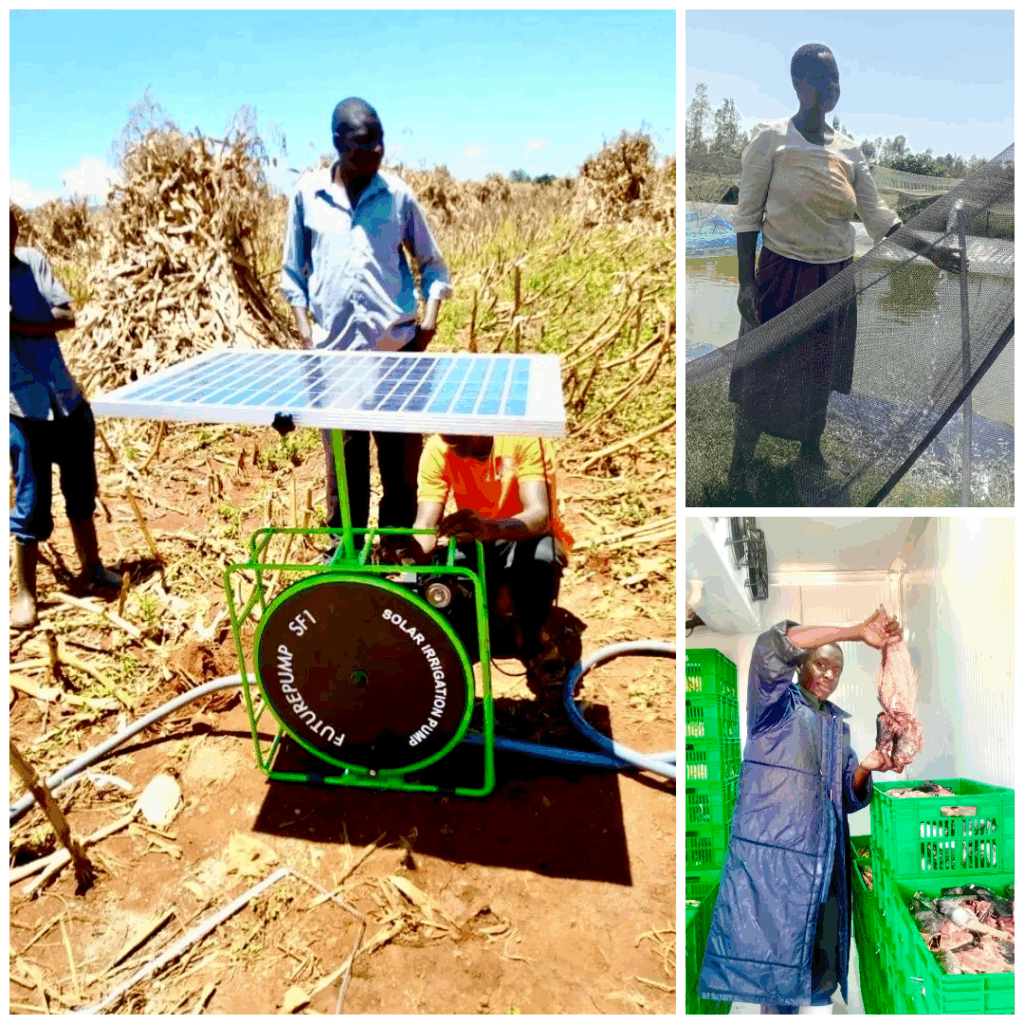
Solar-powered aquaculture transforms fish farming in Kisumu County, as farmers adopt clean energy to run water pumps, aeration systems and cold storage—boosting productivity, cutting costs and strengthening the county’s blue economy value chain.
Photo by Grace Wafubwa.
By Grace Wafubwa
Kisumu County remains a perennial net importer of food despite being endowed with fertile agricultural soils, hosting Africa’s largest freshwater lake—Lake Victoria—and serving as a strategic gateway to the wider Eastern Africa region.
Ironically, these natural advantages have not translated into food sufficiency. The county continues to grapple with low agricultural output, undermining food security and adequate nutrition and leaving many households unable to meet their food needs throughout the year.
Community Intervention: The Awuoth Women’s Group
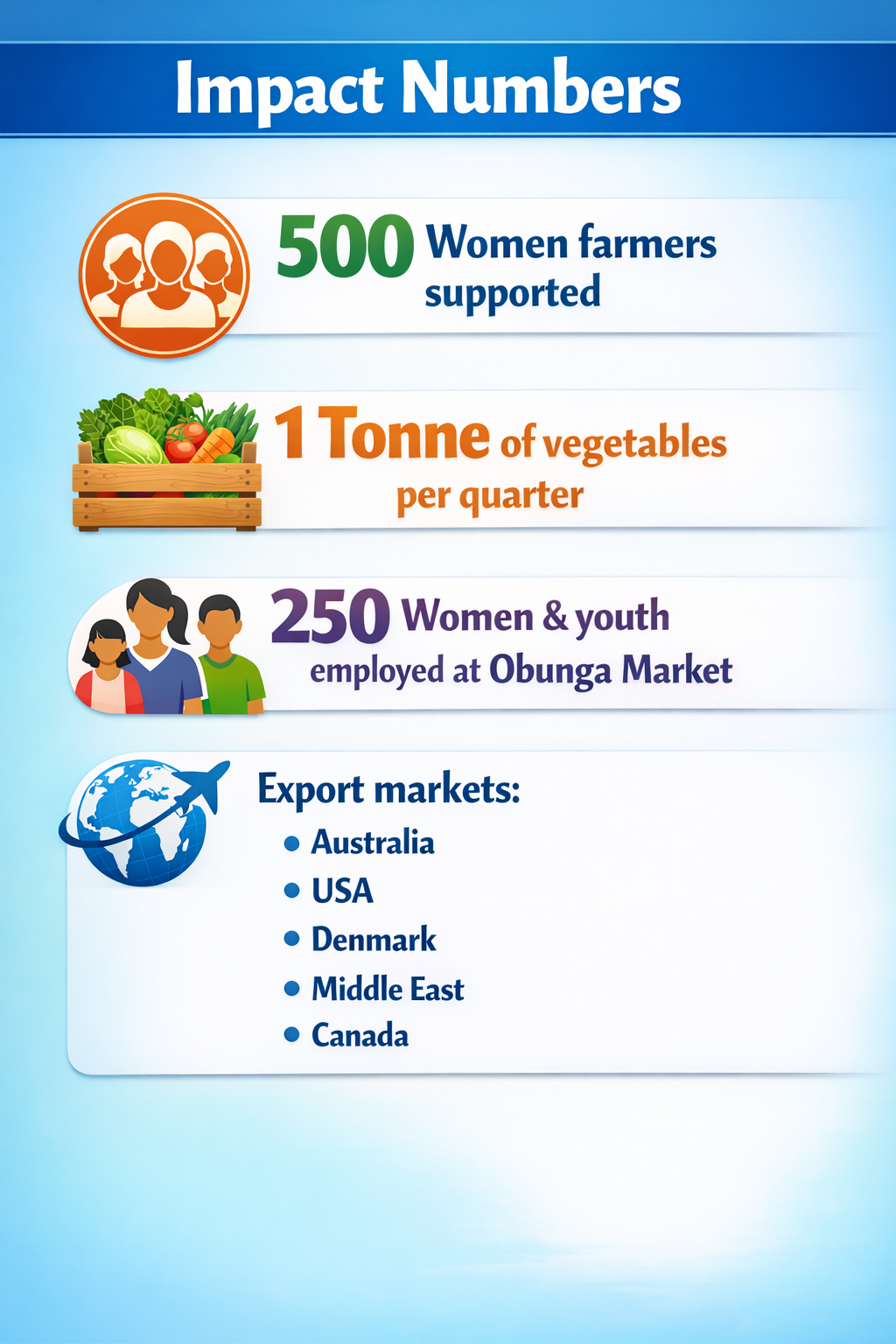
Against this backdrop, Awuoth Widows and Orphans, a community-based organization founded in 1997 in Nyamasaria—approximately four kilometres from Kisumu city centre—has emerged as a key player in strengthening food and nutrition security through indigenous vegetable farming.
The organization, which has a membership of about 500 women, was founded by its current chairperson, Yuanita Anyango Hongo, herself a widow. She established the group in response to the devastating HIV/AIDS pandemic of the early 1990s, which claimed thousands of lives and left many children orphaned and unable to access education.
“It was a devastating era. Women and children were extremely vulnerable, and I had to do something to sustain their lives,” she recalls.
Through collective effort, the group leases land in Kolwa, Chiga and Gesoko—areas adjacent to River Nyamasaria—where members cultivate indigenous vegetables including cowpeas (kunde), spider plant (sagheti), black nightshade (osuga), kales (sukuma wiki) and spinach.
Hongo explains that the group practices purely organic farming, relying on compost manure rather than chemical fertilizers or pesticides, ensuring that the vegetables are safe and environmentally friendly.
Harvesting, Preservation and Storage
Harvesting is carried out every six weeks, with the group producing at least one tonne of leafy vegetables per quarter. Aggregation takes place at a dedicated centre located on an eighth-acre piece of land donated by the founder. The facility houses an office, a cooler and a solar dryer, where daily harvests are measured and weighed before processing.
From Harvest to Market: Solar-Preserved Indigenous Vegetables
Members then collaborate to pluck leaves from the main stems. According to Millicent Atieno Odongo, a founding member of the group, the vegetables are spread on special aluminium tables where unwanted material is removed, followed by washing and cutting into smaller portions.
The produce is then blanched by boiling it in salted water for about seven minutes before being spread out again to cool and drain excess water. Blanching, she notes, helps preserve colour, retain nutrients and extend shelf life.
The pre-boiled vegetables are transferred to solar dryers, where drying time varies depending on the variety. Cowpeas dry fastest—typically within two hours—while kales, spinach and managu require additional time to ensure even drying.
Once dried, the vegetables are moved to a cooling chamber fitted with a charcoal wall system. Water pipes installed on the roof drip moisture onto the walls, naturally cooling the produce within a controlled environment.
“Through solar technology, we have an adequate supply of vegetables throughout the year and can meet demand both locally and internationally,” Hongo explains.
After cooling for between 10 and 20 minutes, the vegetables are graded, packed, labelled and stored, ready for market. The group supplies clients within Kisumu and exports to families, individuals and corporates in Australia, the United States, Denmark, the Middle East and Canada.
Hongo adds that their preservation method is unique and authentic, allowing the vegetables to retain their natural form and achieve an extended shelf life.
“You only add water and the vegetables return to their fresh state,” she says, noting that value addition and zero post-harvest losses have significantly improved members’ livelihoods.
Food Nutrition and Security
Indigenous vegetables are rich in essential minerals such as iron, calcium, magnesium, potassium and zinc, which support blood health, immunity, bone strength and antioxidant functions.
Hongo says these vegetables play a crucial role in addressing food insecurity and micronutrient deficiencies, which are prevalent in Kisumu County. Many households rely heavily on starchy staples such as ugali and rice, resulting in limited dietary diversity, weakened immunity and stunted growth.
She urges young people to embrace agriculture as a pathway to increasing food availability, reducing hunger and improving community nutrition.
Challenges Faced by the Group
Weather dependency remains a major challenge, particularly during rainy or cloudy periods when high humidity slows the solar drying process. To address this, the group constructed a ceramic-lined stove (jiko) with a fume chamber and raised racks, enabling continuous drying even during wet seasons.
Another challenge is vandalism at the cooling facility. Charcoal used in the cooling system is often stolen at night, forcing the group to hire private security services—an added financial burden.
“It is costly to have an extra person depending on our budget, but we have no alternative,” Hongo laments.
Transport has also been a challenge due to high demand across Kisumu town. However, the introduction of E-Safiri, a firm that supplies electric motorcycles and tuk-tuks, has significantly reduced transport costs. The group now pays KSh 800 per day for deliveries, down from previous rates, contributing to cleaner and more sustainable transport.
Solar Energy in Fish Waste Value Addition
Solar energy has also transformed fish waste preservation at Obunga Pap Mbuta Fish Market, directly employing 250 women and youth. Established in the early 1950s, the market processes fish by-products such as fins, intestines, skins and the popular mgongo wazi.
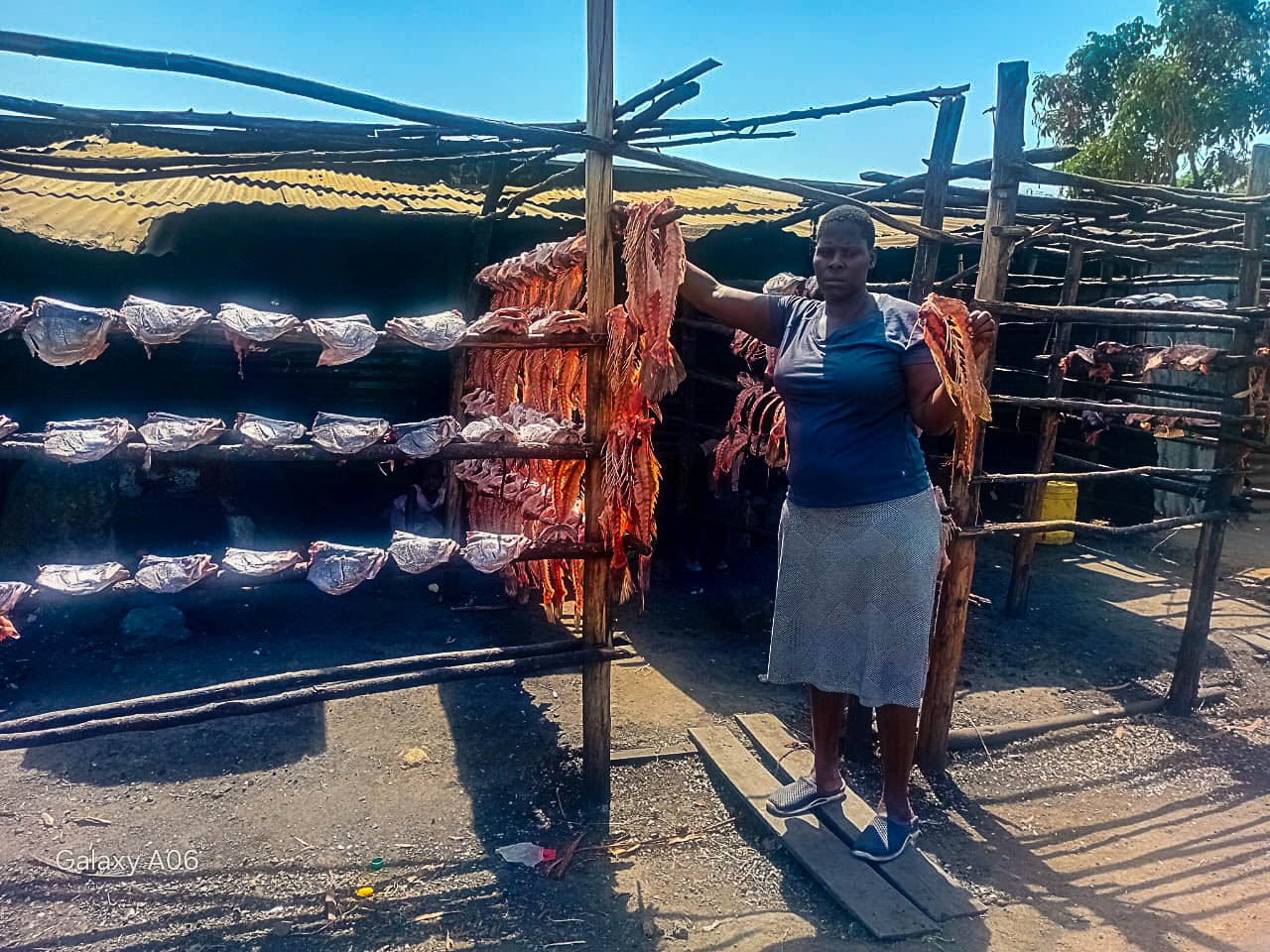
Rael Sama at her Mhongo Wazi kibanda in Kisumu County, where small-scale trade supports local livelihoods alongside the aquaculture value chain.Photo by Grace Wafubwa.
Rael Sama, a trader who has been in the mgongo wazi business since 2004, credits her improved profits to a solar-powered cooler installed eight months ago.
Previously, she relied on deep-frying to prevent spoilage, incurring high costs in firewood and cooking oil, while also facing frequent losses due to theft.
“I almost quit the business. My profit margins were very low, and I could barely sustain myself,” she says.
Today, she can store her products for up to three days and supply markets in Kitale, Eldoret, Nakuru and Kakamega.
“My business is booming. I can now make up to KSh 20,000 from every 100 kilograms of fish stock,” she adds.
These sentiments are echoed by Remjius Odhiambo, the market’s secretary, who notes that solar-powered preservation has reduced wastage and improved hygiene.
Chloride Exide, which installed the facility, also trained traders on system use and provides ongoing technical support.
Solar Irrigation and Aquaculture
Beyond the city, solar technology is driving agricultural transformation in rural areas. In Kasida village, Ahero, small-scale farmer Hellen Adhiambo has integrated solar-powered irrigation and aquaculture on her one-acre farm.
A teacher by profession and a mother of three, Adhiambo has diversified into bananas, fruits, vegetables and fish farming in an area characterised by dry plains and black cotton soil.
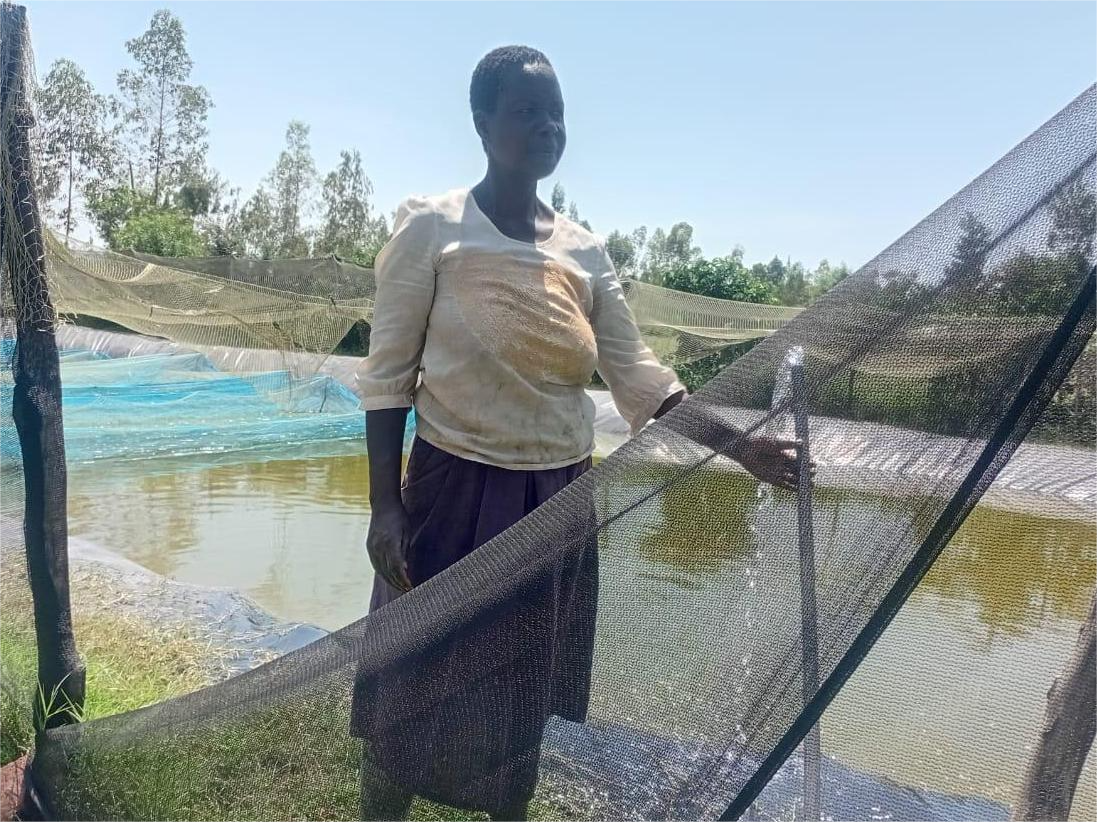
Hellen Adhiambo refills her fish pond using solar-pumped water at her aquaculture farm in Kisumu County, highlighting the growing adoption of renewable energy to enhance sustainable fish production.Photo by Grace Wafubwa.
When I started, many people doubted that anything could grow here,” she recalls.
Through support from Sunculture, a local solar company, a solar-powered water pumping system was installed, enabling continuous irrigation and boosting productivity.
“I no longer rely solely on rice. I now have many varieties to choose from,” she says.
With support from Aquaburn, a Nairobi-based development agency, she constructed a fish pond that currently holds 3,000 tilapia at different growth stages. Solar energy enables her to pump thousands of litres of water to sustain the pond.
“In this area, they call me Mama Samaki because I am the only one supplying fish locally—thanks to solar,” she laughs.
Her earnings from fish farming alone average KSh 30,000 per cycle, enabling her to educate her children up to university level.
Embracing Solar Technology
Solar technician Nick Omondi notes that solar adoption in Kisumu is rising steadily due to reliability, sustainability and cost-effectiveness. He specialises in designing, installing and maintaining photovoltaic systems for farmers.
Through off-grid solutions and agrivoltaics—combining solar panels with crop and livestock production—farmers are diversifying income streams, reducing operational costs and improving water-use efficiency.
However, Omondi identifies inconsistent spare parts as a major challenge, citing compatibility issues across different solar systems.
County Government Perspective
The County Government of Kisumu, with support from ICLEI Africa, has launched a roadmap towards achieving a 100 per cent renewable energy transition by 2050.
According to Felix Odhiambo, Chief Officer in the Department of Energy, the county is developing a County Energy Plan, Clean Energy Policy, Heat Action Plan and Renewable Energy Policy to guide implementation.
“There are several collaborations and commitments aimed at tapping solar power as a key renewable energy source,” he says.
The county has also intensified public awareness campaigns, promoting solar as a decentralised, cost-effective solution for productive use of renewable energy (PURE).
From the shores of Lake Victoria to rural farms, solar energy is reducing production costs, enhancing climate resilience, creating green jobs and strengthening food and nutrition security—making Kisumu’s agricultural value chain more sustainable and inclusive.
Eldoret Media Hub, a working space for journalists based in Uasin Gishu County set up by the Uasin Gishu Journalists Association (UGJA) through a Media Council of Kenya (MCK) grant.
The facility was officially opened in August 2021 by the MCK Chief Executive Officer David Omwoyo.