CS Kagwe says irrigation and large-scale agriculture critical to combating Kenya’s food insecurity
Kagwe lauded investors that combine agricultural production with community development initiatives featuring schools, health facilities, and other social programs.
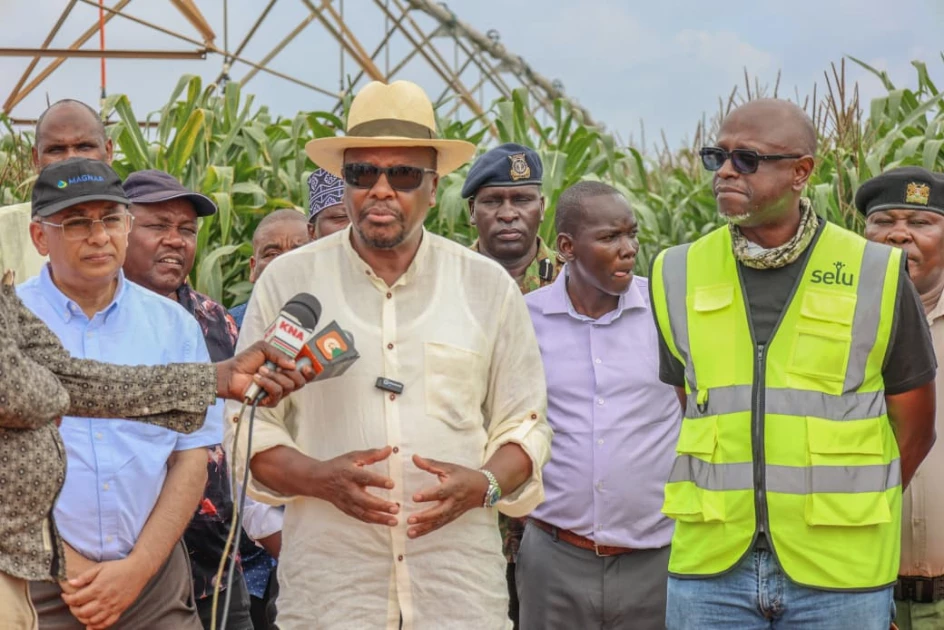
Agriculture Cabinet Secretary (CS) Mutahi Kagwe speaking during the tour of the Nyumba Group, where he commissioned an 800-acre earth dam capable of holding six billion litres of water.Photo/Courtesy.
By Ruth Sang
With the country experiencing persistent droughts, coupled with increasing reliance on foods imported from other countries, the government has intensified calls for the much-needed transition to irrigation-based, large-scale farming, adding that it is obvious traditional agriculture reliant on rain is no longer tenable given climate uncertainty and a booming population.
Agriculture Cabinet Secretary Mutahi Kagwe said that Kenya must firmly, now more than ever, embrace modern agriculture systems based on science and technology so as to increase yields per acre, particularly in the Arid and Semi-Arid Lands (ASALs), which constitutes over 80 percent of Kenya’s total land mass. Erratic rainfall arising from climate change is said to have affected the sustainability of this type of farming and potently threatens the food security of the nation.
The CS specifically referred to Galana-Kulalu Food Security Project 1.8 million acres that he termed as a pillar of the government strategy towards stabilizing food production through machinery and irrigation agriculture. Kagwe insisted that subdividing the land for purposes of smallholder farming will jeopardize mechanization and contravene the very purpose for which the project was designed.
“Galana-Kulalu is not for small, fragmented plots. It is designed exclusively for large-scale, mechanised farming. Any form of subdivision makes efficient production impossible,” Kagwe said.
He connected the food situation in Kenya to its heavy dependence on imports, saying the country imports almost 92 percent of its wheat, over 80 percent of its rice, and also imports huge quantities of sugar. He said that with frequent droughts affecting local productions further, importation is not a sustainable solution in the long term.
According to Kagwe, large-scale irrigated agriculture remains the most reliable alternative towards ensuring consistent food supply, reducing the national import bill, and building resilience against future climate shocks. As such, the government is calling upon credible local and international investors to partner with them in developing Galana-Kulalu through the Land Commercialization Initiative (LCI) and are assuring them that allocation of land will be done in a transparent, competitive, and fair manner.
The CS said that land fragmentation affects efficiency, creates a challenge for economies of scale, and lowers return on investment, whereas consolidated farming benefits from mechanisation, reduction of production cost, and higher yields.
Kagwe said that aside from food production, Galana-Kulalu is expected to drive a wide range of economic activities establishing strong interlinkages between sectors including increased demand for fertilisers from local manufacturers, irrigation equipment, transport and logistics, agro-processing, and trade services.
The government is therefore putting in place measures to among others, reduce production costs as irrigation infrastructure gets developed with a specific focus on water delivery systems, electricity, and irrigation pipes. Kagwe encouraged suppliers in the pipe-making industry and related industries to expand their capacity in preparation for increased demand, stating that locally produced pipes meet high quality standards and are competitively priced.
He also advised resident communities at Galana-Kulalu to tap into the economic opportunity by investing in housing, retail business, service delivery, and supply chains to support a fast-growing agrarian workforce. Community involvement in land exists, he noted, as a core pillar of sustainably maintaining large-scale agriculture.
Kagwe lauded investors that combine agricultural production with community development initiatives featuring schools, health facilities, and other social programs, describing inclusivity as a key pillar of agriculture sustainability in the long run.
Beyond checking on private sector-led irrigation, the CS visited Nyumba Group, unveiling an earth dam of 800 acres and six billion litres of water for irrigation all-year-round-a more extensive program by the Nyumba Foundation under the leadership of Kirtan Hasmukh Kanji that has invested over Ksh. 6.4 billion for the development of more than 300,000 acres now under large-scale production.
Kagwe described the Nyumba approach as a model for mechanized farming with high technology in ASAL regions. His visit extended to Selu-a premier seed maize producer-which he emphasized as important to boost productivity and resilience along Kenya’s food chain through provision of high-quality seeds.
Investment in irrigation, water harvesting, and community-based development are the areas he pointed as being crucial for the transformation of agriculture, minimization of the aid dependence, and safeguarding of the country against future drought-triggered food emergencies.
About Author