NDMA Sounds Alarm as Drought Intensifies, 1.8 Million Face Food Insecurity
Some herders have been forced to migrate in search of pasture, while others are buying hay—an option many say is financially draining and unsustainable if the drought persists for several more months.
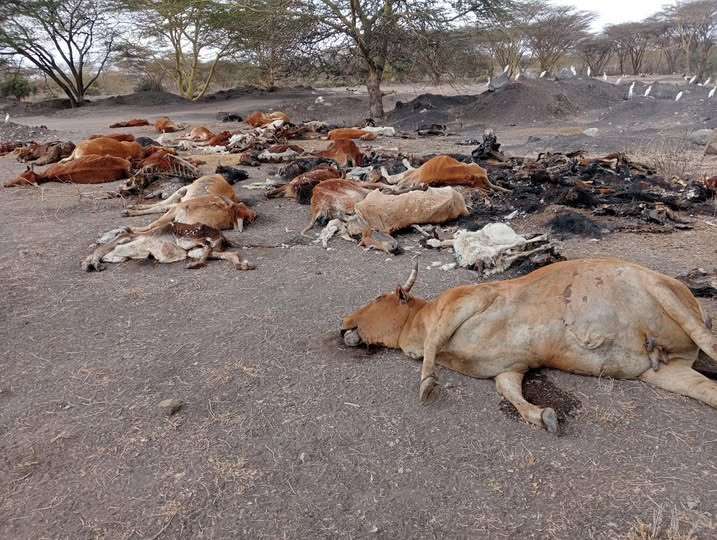
Ongoing interventions include food distribution and cash transfers to stem hunger among the hardest-hit families. Photo/Courtesy
By Ruth Sang
The National Drought Management Authority has issued a stark warning over rapidly worsening drought conditions in several regions following the poor performance of the short rains currently being experienced across the country.
During its current drought early warning bulletin, NDMA showed that Mandera County has now shifted into the Alarm Phase, showing severe degradation in water, pasture, and food availability. The rest of the counties, namely Kajiado, Wajir, Garissa, Kilifi, Kitui, Marsabit, Kwale, Isiolo, and Tana River, have shifted into the Alert Phase and thus call for enhanced surveillance and preparations for response.
The Authority further noted that though thirteen counties remain in the Normal Phase, conditions in these areas are slowly deteriorating. Assessments show reduced water levels in boreholes and rivers, increasingly stressed livestock, and shrinking pasture, raising fears of a wider crisis if the rains do not improve.
According to the NDMA, an estimated 1.8 million people in Arid and Semi-Arid Lands are already facing food insecurity. Projections indicate that the number could rise to 2.14 million by January 2026 should the trend of poor performance of the short rains continue. Currently, Mandera, Turkana, Garissa, Wajir, and Marsabit are the most affected counties, where the livelihood of poor households has become highly dependent on support from elsewhere.
Ongoing interventions include food distribution and cash transfers to stem hunger among the hardest-hit families. NDMA says such efforts are active in all ASAL counties, and the government is preparing to scale up humanitarian assistance in February if conditions worsen.
In Kajiado, the situation is already taking a toll on pastoralists. Some herders have been forced to migrate in search of pasture, while others are buying hay—an option many say is financially draining and unsustainable if the drought persists for several more months.
NDMA reiterated that it continues to closely monitor the situation and disseminate timely early-warning information to the community to assist in preparing for potential shocks. The Authority has called upon county governments, humanitarian agencies, and other partners to install early action protocols, including support to livestock, water trucking, and protection of vulnerable households. With the country preparing for probably the most severe drought period in recent times, NDMA is calling for coordinated efforts to cushion communities from spiraling hunger, livestock losses, and water shortages.
About Author