Turbo MP Faces Recall Threat Over Alleged Tribal Bias in Bursary Awards
“I will begin the collection of signatures to trigger the recall clause against the Turbo MP for neglecting parts of her constituency that are predominantly occupied by other communities,” Wanjohi

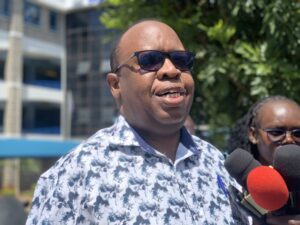
Huruma Ward MCA Kimani Wanjohi Addresing the Media at a past event/Hubzmedia
The Minority Whip of the Uasin Gishu County Assembly and Huruma Ward Representative, Hon. Kimani Wanjohi, has threatened to initiate a recall process against Turbo Member of Parliament, Hon. Janet Sitienei. This follows what he terms as “continued ethnic discrimination” in the distribution of National Government Constituencies Development Fund (NG-CDF) bursaries.
Speaking in Eldoret on Wednesday, Hon. Wanjohi accused the MP of marginalizing certain areas of Turbo Sub-county on ethnic grounds, despite the constituency being home to President William Ruto and representing a largely cosmopolitan population.
“I will begin the collection of signatures to trigger the recall clause against the Turbo MP for neglecting parts of her constituency that are predominantly occupied by other communities,” Wanjohi said.
“We cannot allow discrimination on ethnic grounds to persist in public resource distribution.”
According to Wanjohi, Huruma and Kiplombe Wards each received KSh 3 million in the last financial year out of the KSh 59 million that Turbo Constituency received from the Exchequer. He claims that the lion’s share of the funds went to Ng’enyilel and Tapsagoi Wards, which are predominantly inhabited by communities aligned with the MP’s ethnic group.
Hon. Wanjohi cited a report by the Auditor General for the financial year ending June 30, 2024, which raised concerns about the lack of ethnic diversity in both the Uasin Gishu County Executive and County Assembly staffing.
According to the Auditor General’s findings, a review of the Integrated Payroll and Personnel Database (IPPD) showed that out of the 4,639 employees in the County Government of Uasin Gishu, 4,001—representing 86%—were from the dominant ethnic community. This, he noted, is in direct contravention of Section 65(1)(e) of the County Governments Act, 2012, which requires that at least 30% of new hires at entry-level positions come from communities other than the dominant ethnic group.
The report also revealed that during the year under review, the County Public Service Board recruited 181 new staff—including directors, clerks, cleaners, and early childhood education (ECD) teachers—with 92% of them hailing from the dominant community.
Hon. Wanjohi added that the County Assembly was similarly non-compliant. Of the 132 assembly employees, 122 (92%) were from the same dominant ethnic group, which he said violated the National Cohesion and Integration Act, Sections 7(1) and (2), mandating ethnic balance in public service institutions.
“We demand fair representation of all communities in Uasin Gishu, including Luhya, Luo, Somali, and Kisii,” Wanjohi emphasized.
He also criticized Governor Jonathan Bii’s recent nominations to the County Executive Committee (CECM), arguing that the positions should have been used to promote inclusivity.
The latest nominees include Janet Kurgat, nominated for County Executive Committee Member for Public Service Management and Devolved Units, and Robert Kemei, nominated for Youth Affairs, Sports, ICT and Innovation.
“Once the nominees appear before the assembly for vetting, I will be among those advocating for their rejection if they do not reflect the face of Kenya,” he said.
“We are calling on the County Government to emulate the national government’s spirit of inclusivity. As the fifth city, Eldoret must reflect the cosmopolitan nature of its residents.”
Hon. Wanjohi urged Uasin Gishu County to follow the examples set by other counties such as Trans Nzoia and Nakuru, which have taken steps to ensure minority communities are adequately represented in governance and public service.
Legal Basis for Recall
Under Article 104 of the Constitution of Kenya (2010), the electorate has the right to recall their Member of Parliament before the end of their term. The procedure and grounds are elaborated in the Elections Act, 2011.
The grounds for recalling an MP include:
- Violation of Chapter Six of the Constitution (Leadership and Integrity),
- Mismanagement of public resources,
- Conviction for an offence under the Elections Act or any other law.
To initiate a recall:
- A recall can only be initiated 24 months after the MP’s election and not later than 12 months before the next general election.
- A registered voter in the constituency must file a petition with the Independent Electoral and Boundaries Commission (IEBC), detailing the grounds.
- The petition must be supported by at least 30% of registered voters in the constituency, drawn from various parts of the constituency.
- The IEBC then verifies the signatures and if successful, conducts a recall election.
However, legal confirmation from the High Court on the grounds for recall is typically required before the IEBC can proceed. This process, while constitutionally protected, is stringent to prevent frivolous or politically motivated actions.
About Author